
From EU strategy to practice: the reality of data in your business
March 18, 2026
DESCRIPCIÓN
In an increasingly digital Europe, data has become a strategic resource. Consolidating a single market capable of managing it with trust and transparency is one of the major challenges and opportunities of this decade. From Spain, BAIDATA drives this European vision by connecting companies, public administrations, and technology centers to make data a shared and trusted asset.
Just last year, the data economy in the EU exceeded €800 billion. Other studies also pointed to an annual growth of 9.3% in the GDP of the EU27, with projections reaching up to €1.41 trillion by 2030.
Within this context, European digital sovereignty is built upon common data spaces. These are set to play a transformative role, enabling new products, services, and business models while strengthening a more interconnected, resilient, and competitive economy.
More than simple storage infrastructures, these spaces are secure, governed environments that enable information sharing among administrations, businesses, and citizens without losing control over data assets. Their value goes beyond data exchange: they lay the foundation for the development of advanced technologies, including AI, which requires high-quality, trustworthy data to generate innovative solutions.
Their consolidation is essential to foster interoperable and ethical European AI. Without these spaces, AI faces fragmented data silos. In contrast, a robust data space enables:
- Training AI models with real, verified industrial data
- Ensuring ethics and regulatory compliance (Data Act and AI Act) through transparent governance
- Scaling solutions across borders, overcoming current technical and regulatory barriers
This strategic vision of data spaces is already taking shape in a growing sectoral ecosystem, with key initiatives in areas such as industry, healthcare, agriculture, and mobility. These sectoral efforts represent the practical realization of digital sovereignty, aligned with the Data Act and the European Data Strategy.
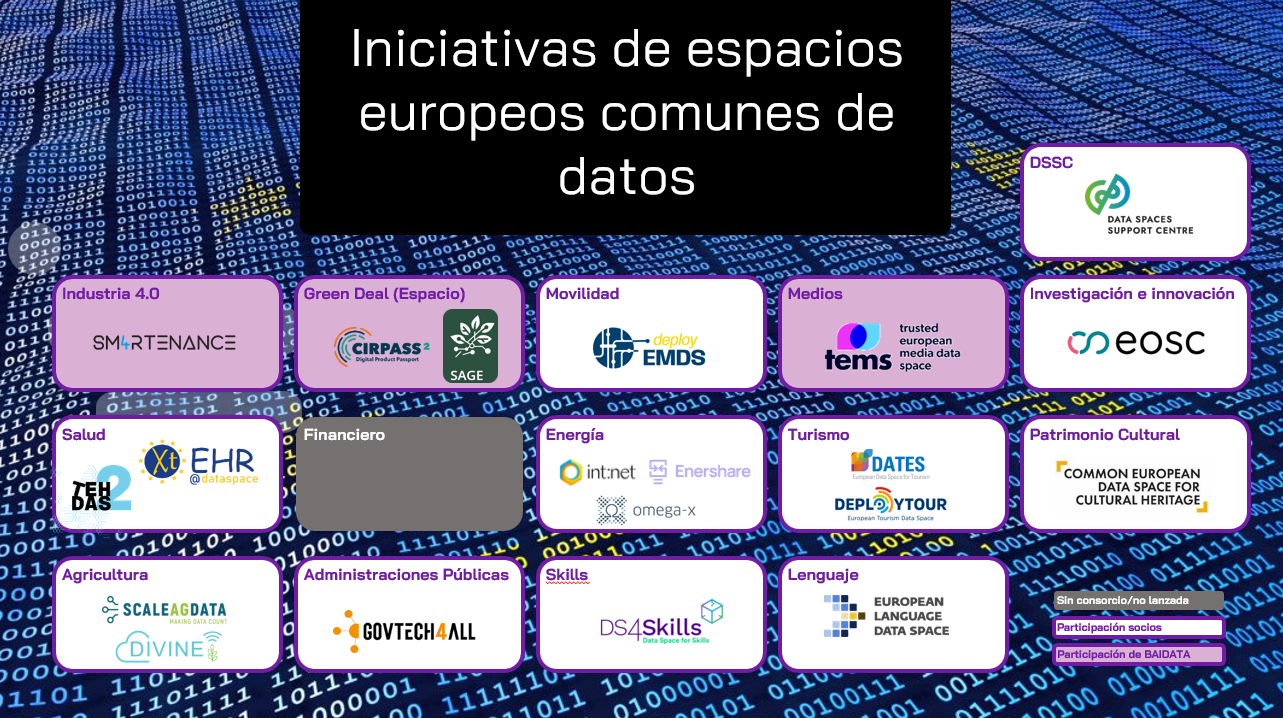
BAIDATA, as a national effort designed to connect companies, technology centers, and public administrations around the strategic use of data, does not merely observe or understand the European data strategy: we execute it. Together with its partners, it drives projects such as TEMS, SM4RTENANCE, and CIRPASS-2, bringing to life the vision of a digital Europe where governance, interoperability, and AI generate tangible value.
- TEMS (Media industry): The current focus is on the governance of the future data space. It defines who can participate, how, and under what economic conditions, ensuring that creators retain control over their assets in the face of AI models.
- SM4RTENANCE (Industry 4.0): With governance already mature, the current challenge is to populate the ecosystem with data and value-added services. This is being achieved through global initiatives such as the Manufacturing-X Council, working closely with leading organizations like VDMA to ensure that industrial SMEs speak the same language as major European players.
- CIRPASS-2 (Digital Product Passport): Progress is being made in adapting to the European Commission’s delegated acts and defining essential data for the Digital Product Passport, highlighting the role of AI in advancing the circular economy.
Through these projects, BAIDATA directly contributes to Europe’s priorities on data sovereignty, circular economy, and industrial digitalization. It does so by aligning specific use cases with the Single Data Market agenda and EU policies on sustainability and interoperability.
BAIDATA promotes the adoption of data infrastructures and common governance frameworks that enable cross-border data sharing among multiple EU stakeholders, including leading initiatives such as Catena-X in the automotive sector.
In 2026, the European Union continues to advance the development of common data spaces, including:
- The proposal to expand High-Value Datasets (HVDs) with administrative and legal information
- The Data Union Strategy, allocating additional funding to priority areas such as industry, mobility, and healthcare
- Events like the Data Spaces Symposium, which foster cross-border interoperability. In this year’s edition, the best solutions and innovative initiatives in interoperability, governance, and practical application of data spaces across Europe were recognized
These milestones reinforce the practical implementation of the Data Strategy, fostering public-private collaborations and scaling data-driven solutions from Spain to the broader EU.
With an active network of partners and European projects, BAIDATA creates the ideal environment for organizations to experiment, learn, and benefit from the emerging data economy model.
Now is the time to be part of this transformation. If you want to anticipate trends, connect with key stakeholders, and actively participate in the development of common data spaces, join BAIDATA and be part of the drive toward a more open, interoperable, and competitive data economy.